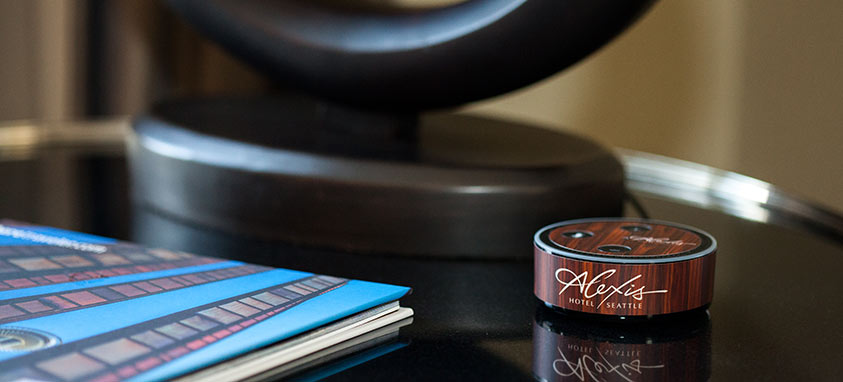
Alexa Alexis EchoPhoto by Jackie Donnelly

Over the past year or two, digital assistance has been popping up in new spaces. It has become so prevalent that a future where smart homes are the norm doesn’t feel far away. It won’t stop with homes either. Certainly, the hospitality industry will need to keep up with this growing demand. After all, nothing is more valuable to the industry than making guests truly feel at home.

Alexa, ask Alexis…

The Kimpton Alexis Hotel in Seattle recently rolled out Amazon Echo devices in each of its 121 guestrooms. The addition of Alexa-powered devices makes the Kimpton Alexis the first hotel in the country to offer the service in every guest room and suite. By simply saying, “Alexa, ask the Alexis,” guests will have questions answered and requests satisfied.

Alexa is not the only voice-operated digital assistant on the market. In fact, Bloomberg recently reported that Siri and Alexa are caught up in a fierce competition for hospitality industry dominance. So why did Kimpton choose Alexa over Siri or Cortana?

Jenne Oxford, general manager of the Kimpton Alexis, explains, “One of the appealing things about Alexa is that Amazon is a local company. More importantly, when we asked about the certain functionalities needed, Alexa fulfilled all of the requirements. The answer became obvious.”
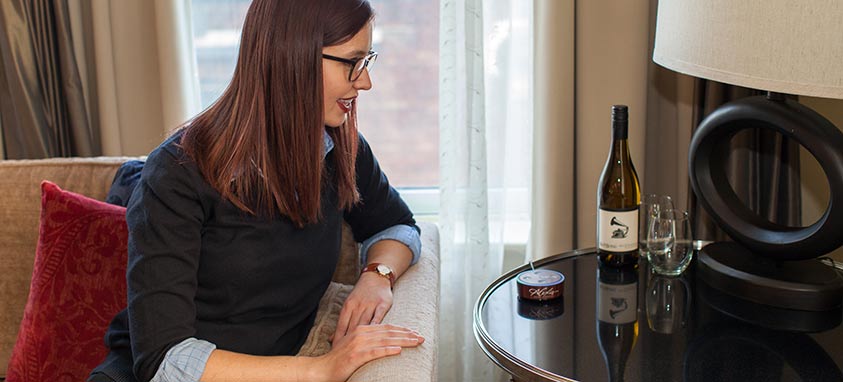
Alexis Alexa

Photo by Jackie Donnelly

The Kimpton Alexis team also worked with Volara, a third-party vendor, to ensure that Alexa would be able to answer questions specific to Kimpton Alexis instead of a generic search engine response.

Even though Alexa has an impressive array of functions, her purpose was never to replace the concierge. Instead, Alexa does everything from relaying in-room requests to giving local restaurant recommendations.

“In terms of communication, Alexa improves the way people are receiving information. They are often more comfortable asking a device for information,” says Oxford, adding, “We worked to get benefits that come along with home usage while also adding hotel functionalities. [Alexa assists with] anything from requesting towels to questions about basic hotel information.”

What can Alexa do for the meeting planner?

Event benefits were a big consideration in setting up Alexa, as the hospitality and meeting planning industries are closely intertwined. Since Alexa’s responses are customized on an audio file, event details can be recorded and circulated throughout hotel rooms. For instance, if coordinated prior to the event, a guest could ask, “Alexa, ask the Alexis where the Smart Meetings event is today.” Alexa would respond with all of the necessary information, including locations, times and itinerary.

“Alexa can tell guests plans for the day or week of an event with specific details on a recorded response,” says Oxford.

Therefore, Alexa can replace the sending of a painstaking number of emails, text messages or voicemails—a huge perk. Plus, Oxford also mentioned that recordings will reduce the need for paper itineraries and brochures, an important sustainable feature for the industry.

This is only the beginning

There is a delicate balance between staying current and having a discerning eye. Every day it becomes more difficult to decide which technological investments are worth the time and money. Evidently, Kimpton Alexis’ decision to integrate Alexa required an evaluation of the industry as a whole.
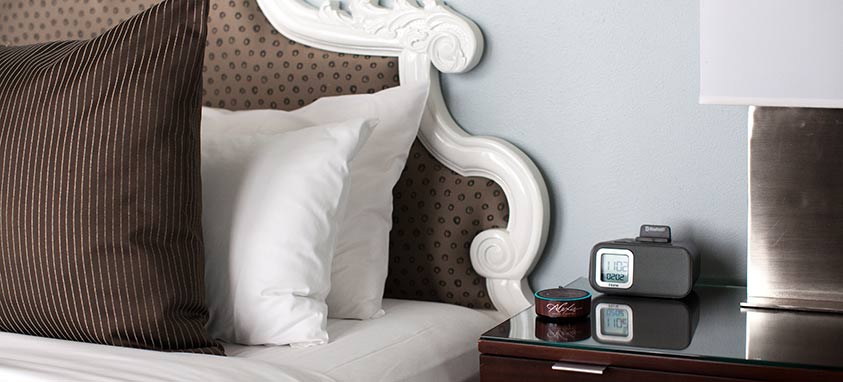
Alexa alexis

Photo by Jackie Donnelly

“We are trying to do something unique and different. When we see people using this technology in their own homes, we want to provide them with that communication,” Oxford comments.

On the future of Alexa, Oxford explains that the process is not stagnant. “We have rolled out phase 1 but we have plans to develop based on guest demands.”

“Tech is challenging because it changes so quickly. It’s important to communicate as we use [the product]. We need to be constantly evaluating guest relevance. By no means is this the end. We will definitely continually evaluate the next thing and consider changing needs.”


virtual reality cocktail

Many whiskey enthusiasts are extremely knowledgeable about their liquor of choice. Perhaps some can even discern details about a drink’s particular origins simply by tasting it. Now, virtual reality technology is taking whiskey to the next level. With its high-tech ambitions, a new drink at the Lobby Bar at One Aldwych in London is changing the way that we enjoy and appreciate whiskey.

The Lobby Bar has introduced a  whiskey cocktail called The Origin. The drink includes a blend of Dalmore 12-Year-Old Whisky, Merlet Soeurs Cerises cherry liqueur, cherry puree and fresh grapefruit juice, with chocolate bitters and Lallier Champagne—plus a complimentary virtual reality experience.

“We don’t say anything on our menu about virtual reality, but we do drop a hint in saying, ‘Take a trip to the Highlands,’” the drink’s creator and the Lobby Bar manager Pedro Paulo tells Condé Nast Traveler. “When someone orders it, we give the guest virtual reality goggles and a headset and explain we are taking [them] to the origin of the drink.”

Basically, the experience goes like this: You order a drink and are given a headset. Unexpectedly, you are transported to a whisky distillery before soaring over a sea of barley fields in the breathtaking Scottish Highlands. The virtual reality experience wraps up by floating you back down to The Lobby Bar. Once you’ve taken off the VR gear, The Origin is waiting for you to take a sip.

Paulo enlisted Dalmore Whisky, a distillery on the shores of the Cromarty Firth in the Scottish Highlands, to collect the stunning imagery. Creating the virtual reality experience required a big production: Paulo also wrote the script, hired directors and organized drone footage to make the content.

“In a finished drink, there are barrels and fields and places that go into making it. Giving this knowledge was my main motivation. It’s an experience beyond the drink, and [guests] will remember it,” says Paulo.

The Origin costs £18 ($23) and has been on the Lobby Bar’s menu for two weeks now. Paulo hopes that his drink experience will open a dialogue about the unique juxtaposition of advanced technology with the simple pleasure of enjoying a drink. As the hospitality industry continues to embrace technology, the art of blending these pleasures could become a worldwide trend. We will likely see hotels find more creative ways to enhance guest experiences.

marriott modular hotels

Marriott Development’s secret for scaling hotel development fast? Preassembled modular construction at a grand scale. The premade guest rooms can shave as much as six months off a 12- to 14-month schedule. Once transported to the site, crane operators lift them onto a base podium foundation and contractors connect the electrical, plumbing and minor finish work.

Tharaldson Hospitality Management opened the first one, a 97-room Fairfield Inn & Suites in Folsom, California, in December 2016. Four more modular hotels are under way—Courtyard Pullman in Washington, AC Oklahoma City in Oklahoma, AC Louisville in Kentucky and AC Chapel Hill in North Carolina.

Eric Jacobs, chief development officer for Marriott’s Select Brands in North America, explained to Digital Trends that the company has plans to build as many as 450 hotels this year and some 10 percent—50 properties—could take advantage of the modular approach in the near future.

“As construction costs are at a peak, it’s a real challenge to find good, qualified subcontractors based on the general building boom that is happening throughout the United States,” Jacobs said. Building off-site in climate-controlled factories not subject to weather conditions could alleviate some of the logistical concerns and reduce costs by mass-producing standardized blocks. It also allows Marriott to better monitor the quality of the building before it is even put in place.

Modular building for the hospitality sector is an idea adapted from development already being implemented in Asia and Europe. Marriott International has preapproved three sources—Guerdon Modular Buildings in Boise, Idaho; Champion Commercial Structures in Detroit; and Oldcastle Surepods in Orange County, Florida, to make the process as streamlined as possible. The innovation was featured at Marriott’s Connect 2017 conference in Los Angeles for hotel developers.

W Bellevue video game

Maybe the hospitality industry is about fun and games after all. Marriott International created what it is calling the hotel industry’s first ever video game for the opening of W Bellevue in Washington. W Hotels Worldwide worked with LA-based marketing agency Pen&Public to launch the virtual touring game Belle the Bear June 15. The adventure video game allows visitors to navigate an animated character through cityscapes inside the new property.

W Hotels took a throwback-style approach to the game. The retro interface was inspired by the game Frogger, which revolved around dodging obstacles to reach a destination. In the new version, Belle is required to avoid drones and robots while collecting cocktails and W-logoed objects to gain points. Hitting a cannabis leaf will cause Belle to turn into a gummy bear and collecting one too many cocktails results in Belle’s commands being reversed.

In addition to offering a virtual interactive experience, W Hotels is rewarding players in the real world. The top five highest scores recorded before July 15 will receive prizes, including a complimentary three-night stay in the Extreme WOW Suite at W Bellevue, round-trip plane tickets for two, dinner for two at The Lakehouse and a $500 shopping spree to The Bellevue Collection.

Bellevue, Washington is a flourishing, tech-centric town with a wide audience of gamers. Anthony Ingham, Global Brand Leader for W Hotels Worldwide, said the motivation for the video game was a desire to tap into that energy. The elements of competition and incentive are part of a strategic marketing campaign.

W Bellevue includes 220 guest rooms and 25 suites, 10,000 sq. ft. of meeting space and is connected to Westin Bellevue by a sky bridge. W Hotels Worldwide currently maintains 50 hotels around the globe and is expected to continue expanding within the U.S.

Four Seasons is offering a new and innovative chat tool that can  answer planners’ and other guests’ concerns promptly, thereby easing anxiety and stress.

Four Seasons Chat can be used to seamlessly communicate with hotel personnel. Guests can send a message from any of a number of channels, such as the Four Seasons App, Facebook Messenger, SMS and WeChat. Event professionals can use this tool as a way connect to Four Seasons staff before, during and after it takes place, as well as get advice on the property and even how to navigate the city.

“Human connection may be the single most important element of the Four Seasons guest experience,” said Christian Clerc, president of worldwide operations for Four Seasons Hotels and Resorts. “There are no chatbots here. Four Seasons Chat ensures guests have access to our people at any time, for any need. We continue to evolve our service offerings to incorporate digital enhancements that are powered by people, to facilitate and strengthen personal connections and to ensure guest expectations are met every day.”

Four Seasons Chat is able to translate more than 100 languages efficiently and in real time. Four Seasons staff are promptly alerted via visual and audial cues to ensure that no messages are missed, and responses are delivered right away. Best-in-class response times are in minutes, if not seconds, which is well below the industry standard of 12 minutes.

In the prelaunch pilot program at 30 hotels, more than 50 percent of the guests engaged with Four Seasons more regularly—they averaged more than six chats during a stay, compared with the industry average of three.

smart hotel race

Photo credit: Marriott International

Hotel guests are saying they want to personalize their stays. And they want to enjoy technology they already have at home. So, in response, rival hotel giants Marriott International and Hilton Hotels & Resorts are in a race to implement “smart” hotel rooms. Both are embracing the emerging Internet of Things (IoT)—but with distinct differences.

Marriott: “Hello, Alexa!”

Marriott plans to have Amazon waiting for you. At its Innovation Lab at company headquarters in Bethesda, Maryland, the IoT Guestroom currently consists of two models. One is for a newbuild hotel, where all the advances of IoT technology can more easily be designed in. The other represents what a retrofit could look like.

We’re experimenting with technology that not only anticipates your needs, but also personalizes the experience for you,” Karim Khalifa, senior vice president of global design strategies, told Skift.

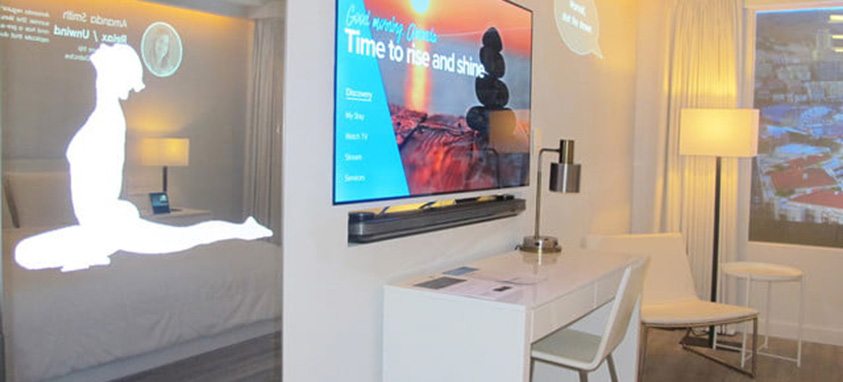
In the newbuild room, tech features include a smart mirror, smart art frame, and smart shower and faucet. An Amazon Echo Show responds to voice commands to adjust all these. Sensors automatically turn on red nightlights to guide you to the bathroom during the night. In the renovated guest room, voice commands to either Amazon Dot or the TV’s remote control activate the smart features.

In both room models, among the things Marriott smart technology can do are:

  • Let you choose artwork to display in your room
  • Display yoga poses on the smart mirror, as well as your heart rate
  • Wake you with gentle, blue-toned lighting
  • Order a car service
  • Tell you which fitness equipment in the fitness center is immediately available
  • Order a Starbucks coffee for lobby pickup

To realize this functionality, Marriott is partnering with Legrand, the French company that specializes in electrical and digital infrastructures, and South Korean electronics conglomerate Samsung.

Hilton: There’s an App For That

Hilton, on the other hand, is taking a homegrown approach. It’s placing a bet on its own smartphone app. In a beta test of its Connected Room at one of its Memphis properties, the Hilton Honors app lets guests control their room’s thermostat, lighting, blinds, television and other amenities. The chain says it will begin to scale rapidly across the United States in 2018 and will ultimately roll out the concept worldwide.

Imagine a world where the room knows you, and you know the room,” Christopher Nassetta, Hilton’s CEO, said at a recent Skift event. “Imagine a world where you walk in, the TV says, ‘How are you doing, John? Nice to see you,’ and all of your stuff is preloaded and not only preloaded but the only thing you ever need to touch to control the room is in the palm of your hand.”

An estimated 12.5 percent of households in the United States were considered smart homes at the end of last year. By 2021, the percentage is expected to more than double.

The Echo Way

At Wynn Resorts in Las Vegas, all guest rooms already have an Amazon Echo to control basic room functions, and other chains such as Best Western have tested their use.

“Hoteliers have to identify the right level of technology for their properties and they need to implement these, even if only at a basic ability to remotely control lighting and temperature, or the consumer is going to judge them as antiquated and irrelevant,” said Ken Freeman, senior vice president of demand generation at Legrand, recently. “The hoteliers that get this right will gain the loyalty of the next-generation traveler.”

Who will reach the future ideal guest room first?

https://www.youtube.com/watch?v=7QM7izjVqug

Travelers in 2018 have different expectations than they did in 1958, when an almost universal hotel room blueprint required a bed, two nightstands, a desk and a restaurant hotel that served eggs and bacon in the morning, and meat and potatoes at night. We chatted with Barbara Best-Santos, associate principal at Forrest Perkins, who recently managed a $90 million redesign of 1,270 guest rooms at Flamingo Las Vegas. She shared five ways hotels are changing to meet the needs of today’s groups.

1. Prepare for Insta-worthy Spots by Design 

Everyone seems to be looking for Instagrammable moments, especially when on the road. Designers are now thinking about where people can take signature photos when designing spaces and building that in. Whether it is a kitchy chair, a balcony view or a unique art piece, photo opportunities are a required element in a hotel room today.

2. Hotel Restaurants are Going Big or Going Away

The three-meal-a-day, sit-down restaurant is less important to travelers than the option of a grab-and-go meal. People are looking for a place to get coffee and something healthy to take with them. If the hotel restaurant is included, it needs to be distinctive and reflect the attitude of the property or the place. People want to discover unique dining experiences when they are away from home.

3. Look for New and Improved Amenity Bars

Many hotel rooms today include Nespreso machines with flavored coffee and creamers, to-go cups with lids and snacks to get people ready for their workday. Look for stashes of locally produced goodies, honey from a rooftop hive, gourmet popcorn or granola, and other branded items to connect visitors with the city.

4. Extreme Tech Access is Built into the Room

Free high-speed Wi-Fi is finally becoming the rule. And multiple outlets in every conceivable place allow guests to charge all of their devices at once without ever losing connectivity. Because more things are being controlled through smartphones, including door entry, room temperature, curtains, and messages for housekeeping and front desk, the house phone may soon disappear in favor of a computer in a mirror that will allow you to order room service, program your music and brush your teeth at the same time. You will simply walk into the room and tell it what to do.

5. Business Centers are Endangered

Outside the hotel room, today’s business traveler needs only a terminal or two and a printer, and that can be integrated in a corner of the lobby instead of hidden away. This allows guests to enjoy the great feel of a communal room when they are traveling alone, rather than being stuck in a closet in the back while they answer their email and print a report for the next day. Bonus—they can grab a glass of wine or meet with clients in a pleasant setting.

The bottom line is that people want to feel special when they are traveling. They want to smile, and spaces that take into consideration how they live and work will make them happy. That is good news for event professionals because how attendees feel about the hotel space can impact how they feel about the entire conference.

As the application of artificial intelligence (AI) advances begin to catch up with the hype, robotics may finally find its way into the meetings world. This is especially true in hotels, where robots are assisting some hotel employees by taking on tasks that could be considered a time-suck. But don’t be alarmed: these robots come in peace.

The Face of AI Delivery

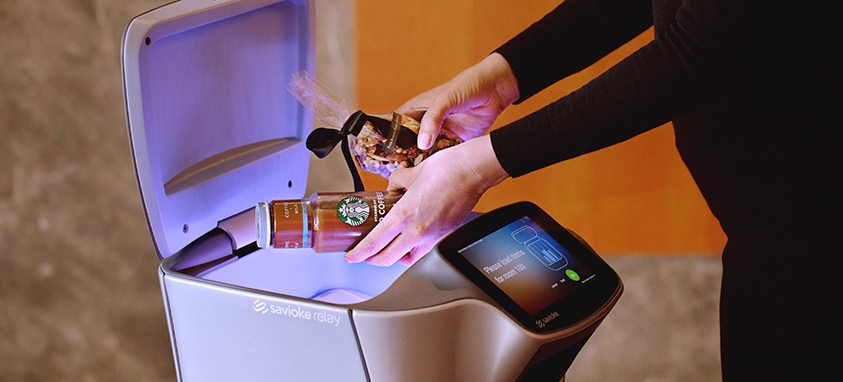
Savioke was one of the first company to place autonomous delivery robots in the hospitality industry. Officially named “Relay,” the robot uses Wi-Fi and 3D sensors to carry out simple tasks. From delivering towels to room service, Relay accommodates both guests and employees.

Photo of Relay

“[Relay] frees up team members to focus on serving guests. Relay is like an extra helper for busy staff,” says Savioke CEO Steve Cousins.

The glowing, moving canister is simple yet efficient. With a “walking” speed roughly the same rate as a human’s, timely delivery comes with a phone call to alert guests when it is at the door.

To add whimsy to the efficient improvement and make technology seem friendlier, many hotels name their robots. At Renaissance Las Vegas Hotel, guests meet Elvis and Priscilla. And at Luma Hotel Times Square, Alina will be on the other side of the door.

“Guests almost unanimously love interacting with Relay. His friendly, approachable ‘personality’ is a hit with everyone,” says Cousins.

Virtual Inclusion

Savioke isn’t the only company getting in on the fun of robot-human interaction. Double Robotics produces a rolling stand for an iPad that can project video, record and share information.

Hoteliers can give site tours and attend meetings using a camera, allowing out-of-town attendees to enter the room.

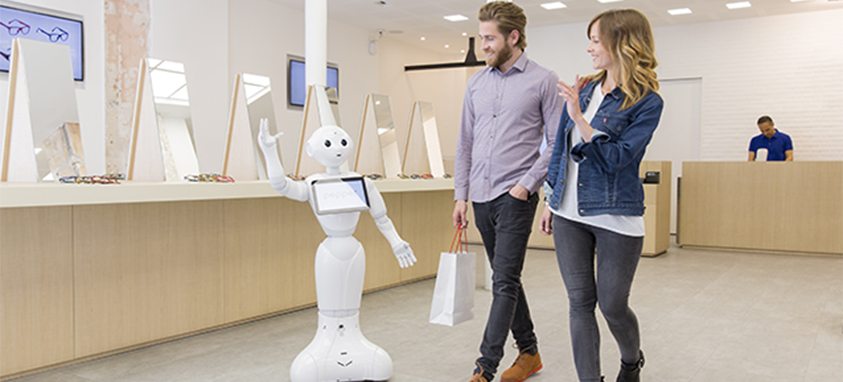
Photo of Pepper

In the Mandarin Oriental, Las Vegas, Pepper uses AI developed by SoftBank Robotics. With similar abilities to Alexa and Siri, Pepper can greet guests, provide directions and answer questions relevant to the hotel.

Augmented Staffing

Cousins stresses that robots will not force humans out of jobs. “Service robots like Relay are helpers, assisting humans with their jobs,” he explains. “In fact, at several hotels where Relay is deployed, new jobs have been created.”

So don’t worry about over-using Elvis or Alina—they’re there to make you comfortable, and there’s always a human available when you want one.

Photo Credit: Hotel Business

Looking to order room service? Need ideas for things to do in your spare time? Want to shorten check-in or check-out time? A virtual concierge is here to meet all of your needs.

Technological advancements are already being made in the hospitality industry, from flat-screen televisions in your room to robots bringing towels to your door. We have come a long way from the days of alarm clocks and drip coffee machines as high-tech and virtual concierges are joining the fleet of innovative ways to improve your stay.

The Concierges of the Future

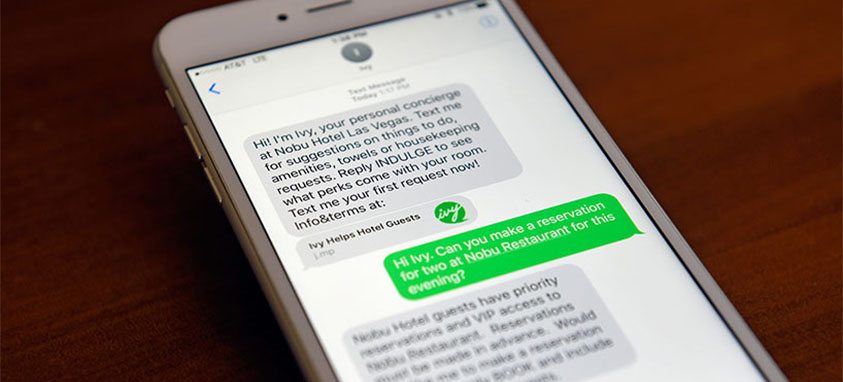
Artificial intelligence now comes in a surprising number of packages at hotels. At the beginning of this year, Ivy premiered at four Caesars Entertainment Corporation properties in Las Vegas and LINQ. Powered by IBM Watson from the company Go Moment, Ivy is in charge of handling booking and general questions. Ivy is also responsible for surveying guests’ satisfaction. In the event of a negative response, Ivy passes the issue along to the hotel, allowing quick fixes to be made before a bad review comes in.

Handheld Hospitality’s system, SmartGuest, claims to “not only increase revenue per guest stay, but also ensure guests have up-to-date information on hotel services and activities.” SmartGuest provides guests with check-in abilities, welcome letters, A to Z contact directories, and room service and restaurant selections—all from the comfort of your hotel room. Pull out your smartphone, and you’re in.

Some hotels hoping to stand out are building their own app with the help of VirtualConcierge. By utilizing a customizable app, guests can create their own custom itinerary within the app by making restaurant reservations and finding activities near them. Hotels are also able to showcase their properties and amenities, so guests know the details of where they will be staying and can prepare and pack adequately.

Benefit to Event Planners

When you host an event at a hotel, you want attendees to feel taken care of. High-quality care is a top priority for planners, which is why virtual concierges are on the rise. They can help guests navigate their way through a new destination, find activities to partake in during their downtime and improve their overall satisfaction in real time.

the hotels of the future

The world around us is changing and the hotel industry is adapting with it. People want more from hotels—often, a simple bed and continental breakfast no longer suffice. New emerging technologies and attitudes are inspiring hotels to take on three new roles to provide extraordinary experiences for guests.

Hotel as Dream-Maker

Technology offers endless possibilities. James Canton, a renowned futurist, social scientist and former Apple Computer executive who now works for Institute for Global Futures, worked with Hotels.com to produce the “Hotels of the Future” study in January 2017. Canton says that as the hotel experience gears toward increasing personalization, anything a guest dreams of soon will be able to happen.

For example, Canton believes robotic butlers will be able to provide widespread service within the next few years. Like existing virtual concierges, these lean, nice working-machines will do everything from greet guests in their preferred language to offer companionship, clean rooms and provide room service, which will be specialized, based on the guest’s DNA. This will allow hotels to serve balanced meals that suit guests’ health and energy needs, while optimizing the taste for their tongue palette.

Canton also believes hotels could begin to offer immersive “worlds” for their guest to interact with, either in real-life or via virtual reality. These worlds, complete with story lines, characters and costumes, will become what Canton calls “alternative travel lifestyles.”

Hotel as Connector

In the future, hotels could also play a huge role in forming enriching bonds between guests to further elevate their experiences. In an eight-week study conducted using observations and in-depth interviews, Deloitte.com found that despite the rapid, ongoing development of technology, guests still desire human contact.

Ace Hotel in New York City is addressing this desire in its hotel lobby, warmly known as the living room, which serves as a wind down spot for guests. The lobby’s warm colors form a sense of synergy for guests to work together and socialize, either among themselves or with locals, as the space is open to the public. This gives guests the opportunity to meet others not directly involved with their event or meeting, thereby enabling them to expand their cultural and social viewpoints.

Hotels can also look toward co-living spaces as inspiration for the future. Places such as Airbnb commonly feature communal spaces, including a kitchen and living room, while maintaining privacy in a bedroom. In June 2016, Extended Stay Hotels announced plans to integrate more common spaces, such as the lounge and kitchen.

Hotel as Luxury Sustainer

Both millennials and older generations are starting to realize the negative consequences of waste, and in turn, are taking steps to remedy the situation. One antidote includes choosing eco-friendly hotels.

Soneva Resorts, with locations in the Maldives and Thailand, shows that you don’t have to sacrifice luxury for sustainability. It utilizes, rather than ignores, the nature around the property to transform their guests’ experiences. It attempts to use farm-to-table food, instead of imported foods, and creates a careful balance with the surrounding ecosystem.

Soneva’s location in Fushi is home to crabs that dig tunnels to provide oxygen to trees on the island. If guests ask to eat the crabs, Soneva refuses, because they are critical to life on the island. Soneva also recycles 73 percent of the solid waste produced on site and keeps a record of its sustainable initiatives’ impact through sustainability reports.