Elevating experiences doesn’t have to be a Herculean lift. Strategic use of emerging technology such as generative artificial intelligence for meeting planning and facial analysis can streamline tasks and drive creative advances.

At Smart Meetings Innovation Experience in Atlantic City—a destination of firsts, from the first computer conference to the first female African-American millionaire—top meeting professionals met to explore what is possible in the future of events.

Sophia, XtraORdinary Booking Agency’s AI humanoid robot kicked off the learning as a co-host. The three-day gathering included hands-on opportunities to use AI to create an event from scratch for SEARCH Foundation and help the community by working in the garden with C.R.O.P.S., a local organization that helps alleviate food insecurity.

People planting

Innovative ideas were baked into the BEOs as well. A poolside reception at Ocean Casino Resort’s cabana deck offered a taste of the property’s fine dining options. And an evening at The Yard at Bally’s featured boardwalk favorites in a glass house. An unexpected fresh perspective that was a big hit was the “butt sketch artist,” who artistically captured attendees’ clothed backsides.

Read More: Atlantic City: A New Wave

After curated meetings, attendees left with a stronger sense of how to leverage technological possibilities and new relationships. These are the highlights:

Agents of Change

Jim Spellos speaking to group
Jim Spellos

In a presentation titled, “Everything You Need to Know About AI (But Didn’t Know to Ask),” Now-ist and Meeting U CEO Jim Spellos was frank. “Artificial intelligence is no longer a futuristic buzzword—it’s a practical tool you should already be using.”

He walked meeting professionals through a whirlwind tour of what today’s most advanced AI tools can really do—and how to use them wisely. The good news: AI is not a tool that will require you to learn a whole new skill set. You don’t have to know how to write code. If you can write an email, you can prompt an AI. You just have to know how to ask. Effective prompting can be broken down to a simple formula: Role, End Goal, Constraints, Ask Questions, Provide and Iterate.

Need a sample? Try: “You’re the world’s best event marketer. Write a 200-word blog post about sustainable meeting trends in a warm, professional tone. Make it easy to understand for a high school student.”

“It’s not magic—it’s clear communication,” he said.

Spellos also pointed out that planners may already use AI without realizing it. It is embedded in everything from Excel spreadsheets to Canva design and Google searches. While some tools are best for different tasks, investing time in the pro version of a favorite platform can train it to understand your voice, brand and style. (See sidebar, Your AI Toolbox: 10 Tools to Make You a More Efficient Planner)

The next evolution of AI is the transition to agent assistants that can perform a series of functions based on a desired outcome using a variety of tools. They can already do everything from prepping your day using your calendar and sorting emails to iterating agendas based on feedback analysis to ordering a hamburger for delivery. Speaker Katie McMahon, president and chief operating officer at Native Voice, orchestrated the first-ever JetBuy burger order by a humanoid during the conference and predicted that the future is voice-activated rather than heads down—a development that could relieve a lot of cases of tech neck.

What else can AI do for meeting professionals? Try:

  • Brainstorming creative event concepts
  • Summarizing lengthy reports or YouTube videos
  • Transcribing and summarizing meetings
  • Building presentation decks
  • Writing and scheduling social media
  • Creating or enhancing images and audio
  • Analyzing budgets to find potential areas for savings

Your Meeting Professional Job Is (Mostly) Safe

woman writing on computer

As powerful as generative technology is becoming, it is not coming for your meeting professional job if you take the time to master the tool rather than turning away from it. In fact, Nick Borelli, marketing director with the AI facial analysis company Zenus, suggested it might make events more essential than ever. In a world of deep fakes and hallucinations, where no one knows what to believe online and images are regularly manipulated, face-to-face meetings are the most authentic and trusted vehicles for building relationships.

Human insight and quality controls are still vital. Combining individual industry knowledge with AI capabilities creates stronger, faster outcomes. “Perfect is the enemy of good,” Spellos reminded attendees. “Start experimenting—even if it’s not perfect.”

Read More: How Event Planners Are Using AI in 2025

Your AI Toolbox: 10 Tools to Make You a More Efficient Planner

  1. ChatGPT (OpenAI)
    Best for: Brainstorming, writing, summarizing
    Your go-to assistant for drafting emails, blog posts, social copy or simplifying complex info. Great for “explain it to me like I’m 12” moments.
  2. Claude (Anthropic)
    Best for: Document analysis and chat-based research
    Handles long uploads like RFPs or contracts with ease and gives nuanced, contextual answers.
  3. Canva Magic Studio
    Best for: Designing presentations, flyers and social graphics
    Tap into AI-powered design suggestions, instant resizing and text-to-image tools that bring visuals to life.
  4. Fireflies.ai
    Best for: Transcribing and summarizing meeting recordings
    Records Zoom/Teams calls, delivers full transcripts and highlights action items automatically.
  5. Otter.ai
    Best for: Live captioning and meeting notes
    Offers real-time transcription and collaborative note-taking during events or hybrid meetings.
  6. ElevenLabs
    Best for: Creating high-quality voiceovers
    Turn scripts into human-like audio for video intros, virtual event narration, or accessible content.
  7. Descript
    Best for: Editing audio and video with text
    Cut “ums,” fix mistakes or clone your voice. It’s like Word for your media files.
  8. Gamma
    Best for: Instantly creating slide decks from bullet points or ideas
    Feed it an outline and get a clean, visual presentation in minutes.
  9. Beautiful.ai
    Best for: Branded, smart slide design
    Professional-looking decks that adjust layout automatically—perfect for planners presenting to execs or clients.
  10. Runway
    Best for: AI-generated and edited video
    Remove backgrounds, extend footage or turn images into short video clips—no editing team required.

We all recognize the impact that a great speaker can have in transforming an event from merely good to truly unforgettable. Last year, you helped us highlight individuals who inspire, energize, and connect us in profound ways. It’s that time again to nominate our 3rd annual Smart Speakers: Best of the Stage Award.

This year, we’ve introduced exciting new categories to showcase the diverse talents that have enriched our events. From Wellness Wizards to Innovation Accelerators, every nomination shines a light on those who have changed lives, driven revenue, and strengthened community bonds. Your nomination not only celebrates their contributions but also helps your peers discover speakers who can deliver that ‘wow’ moment at their next event.

Don’t miss this opportunity to have your top pick featured! Nominate your favorite keynote speaker by May 30th, and let’s continue to highlight the brilliance that lights up our stages.

AI is becoming the ultimate planning assistant

Whether planners are ready or not, artificial intelligence will significantly shape meetings and events. To stay ahead of the curve, planners need to understand how AI fits into their workflows and how to use it purposefully.

Smart Meetings spoke with Chantal Sturk-Nadeau, vice president of Spark and PCMA Insights; Tim Hines, keynote speaker, business coach and chief marketing officer of Marketing Starter Group; and Margaret Launzel-Pennes, chief visioneer at POP | X, to explore practical applications for AI and what to watch in the year ahead.

AI has become an essential tool for designing the most effective events possible. As Hines put it:

“I look at AI like a can of Red Bull. It gives your event wings.”

Watch our full webinar here

Here to Help, Not Take Your Job

One of the first concerns planners have about AI is whether it might replace them. The panelists emphasized that AI should be seen as a partner, not a competitor.

“People think it’s a threat to creativity. It’s not. It’s a catalyst,” said Launzel-Pennes.

Used intentionally, AI can streamline repetitive work and free planners to focus on strategic and human-centered elements of events.

Read More: Why AI Might Mean Salvation for the Meeting Industry

“It helps us focus more on the human side of events,” Hines said.

Tasks like post-event data analysis are a perfect match for AI, which can process results and surface insights quickly, giving planners more time to design meaningful experiences.

“Uploading your surveys and letting AI analyze them makes you more intelligent, not less,” said Sturk-Nadeau.

Safety and Privacy

While AI offers time-saving power, privacy and data safety remain top priorities. Planners should avoid inputting sensitive attendee or client data and always review AI-generated content before using it externally.

“Don’t treat it like a shortcut—challenge it, refine it and give it real direction,” said Launzel-Pennes.

Read More: PCMA Convening Leaders Put Balancing Safety and Comfort in the Spotlight

Panelists advised treating AI like a trusted team member—one that needs context, guidance and clarity to perform well. Strong prompting can significantly improve outcomes.

“Be specific, just like you would with a colleague. It’s not cheating—it’s being strategic,” said Sturk-Nadeau.

A Real-World Case Study

Launzel-Pennes shared a striking example of what full AI collaboration can look like. Her team developed an event from the ground up using AI to generate everything—from the name and logo to the speaker list, marketing assets and floor plan.

“We asked it to be our CEO, and we became the employees,” she said. “It was scary at first, but then it was freeing.”

“It was like planning with a brain that never gets tired.”

What’s Next

With the rapid pace of AI development, planners may soon move beyond prompting altogether. AI agents—autonomous digital assistants—are emerging as the next frontier.

“Agenting will eliminate prompting altogether. Your assistant will know your cadence and deliver what you need before you ask,” said Hines.

Spark is already beta testing its AI Agent Studio, which is being trained to anticipate planner workflows and provide proactive support.

“We’re training Spark to become a workflow consultant that works with you, not just for you,” said Sturk-Nadeau.

Meeting experts share strategies for building crisis plans

Risk is an unavoidable element in the world of meeting planning—ranging from speaker cancellations to weather, cybersecurity threats and civil unrest.

In a recent survey conducted with Destinations International, only 39% of planners reported including safety in their requests for proposals (RFPs).

Disruptions to the industry are now expected, but planners can stay ahead of the chaos. Smart Meetings spoke with Stephanie Turner, vice president of convention sales and strategies at New Orleans & Company, and Diana Waldrop, vice president of convention services at Destination DC, to discuss which emergencies are top of mind for planners—and how to establish clear roles and responsibilities in a crisis plan.

Watch our full webinar here.

Early Conversations

It’s important for planners to begin conversations about risk early in the event planning process, particularly when it comes to safety.

For those hosting events in larger cities, identifying potential areas of concern should be a top priority.

“We always ask them, ‘Are you anticipating any protesters?… Just be proactive and bring it up in planning meetings,” Waldrop said. “Do you have any concerns about coming to the city? Let’s start that conversation early.”

Dealing With Public Perception

While planners hope their events exist in their own magical world, hosting in a major city means public perception can become a factor. Attendee hesitancy may be influenced by news headlines that paint an incomplete or misleading picture of a destination.

Waldrop emphasized that what visitors see on TV doesn’t reflect everyday life.

It’s not what you see on TV. D.C. is a living community of over 700,000 people…. It’s a very welcoming city,” Waldrop said.

Turner echoed that planners need tools to address and counter misinformation.

“You combat perception for a lot longer than you combat reality…. You’ve got to empower your customers to promote your destination on your behalf,” Turner said.

Your DMO Is Your Umbrella

One key ally in risk mitigation is the local destination marketing organization (DMO).

Read More: Destination Management Companies: Good to Great

Turner described the DMO as the umbrella that helps coordinate communication between agencies, hotels, venues and planners—especially in times of crisis.

“We deal with things that are weird and hard…. We’re looked to for responsibility where we don’t have authority,” Turner continued. “You’ve got to have messaging and facts prepared—because we can’t drown out mainstream media, but we can clarify…. Our role is not just tourism. It’s also about standing up for the meeting space.”

Chain of Command in Communication

When something goes wrong, it’s critical to know who speaks for the team.

Read More: Event Crisis Communication Templates Worth Copying

“If you don’t have a predesignated spokesperson…the absence becomes a vacuum,” Turner said. “It can actually be detrimental to the city or the organization if the void of silence isn’t managed properly.”

Learning as We Go

Both Turner and Waldrop have worked on high-profile events, including the Super Bowl in New Orleans and the NATO Summit in Washington, D.C. These experiences reinforced the importance of coordination at scale.

“The goal is to keep it safe without losing the joy…. Coordination within your community is everything,” Turner said. “We had every agency imaginable involved—but it still felt joyful and open. That’s the balance.”

The Importance of Training

All event personnel—whether full-time or temporary—must be trained to respond to on-site emergencies such as medical issues, evacuations or lost children.

D.C.’s “Red Coats,” a group of trained temp staff, serve as a frontline resource during events.

“We’ve trained our temp staff on safety protocols—they’re the first responders in the room, whether they know it or not,” Waldrop said.

“Who are the attendees going to ask but the people in red coats? They need to know what to do if there’s a fire alarm.”

Consider International Attendees

Even with the best planning, global politics can affect international travel. DMOs are helping planners navigate visa processes and offer reassurance to attendees from abroad.

“No one wants to travel a great distance and feel unwelcome,” Turner said.

From vague RFPs to bundled contracts, how to avoid costly event production pitfalls

You’ve lined up your speakers, selected a caterer, and most of the bells and whistles are in place. But there’s one crucial element you can’t overlook: audiovisual (AV) needs, and how those needs are outlined in your contract.

Smart Meetings spoke with Scott Frankel, president of Animatic Media, to unpack what planners need to know about AV contracts before locking in a deal.

Watch our full webinar here.

In-House vs. Third-Party AV

Frankel outlined key considerations when choosing between in-house AV and third-party providers. The final decision often comes down to needs and budget, but the venue contract may dictate your options.

“Some of the best crews I’ve ever worked with were in-house,” Frankel said. “But you have to ask: What does the fine print say?”

Read More: Architect Model of Third-Party Planning

Often, AV decisions are tied to broader logistical and financial factors.

“Your AV choice can’t be made in a vacuum—it has to align with production guidelines, service fees and the planner’s overall goals,” he said.

Get Specific in Your RFP

Timing is everything when preparing your request for proposal (RFP). Sending it too early without full details can backfire.

“A vague RFP leads to vague pricing—and you don’t want to be caught budgeting off a best guess,” Frankel said.

He advises planners to wait until they have a confirmed session count, timing, breakout needs and floor plans.

“Include room drawings, load-in access and session details in your RFP—or your quote won’t be accurate,” he said. “Request the CAD file from the venue, have your AV provider drop it in the production layout, and then send it back for tables and chairs. That’s how you avoid fire marshal issues or last-minute reflows.”

Don’t Sign a Vague Contract

Whether your AV is bundled with power, rigging or internet, your contract should be detailed and specific.

“You don’t need to be a lawyer,” Frankel said. “But you do need to know there’s a financial relationship between the venue and in-house AV—and it affects your pricing.”

Read More: Demystifying AV Contracts

Venue contracts often include third-party production rules or agreements that aren’t immediately visible. These hidden documents may include fees, restrictions or exclusivity clauses.

“The AV costs aren’t the AV company’s alone. The venue’s often taking a percentage. You deserve transparency,” Frankel said.

Watch for Hidden Fees

Frankel strongly recommends requesting separate quotes for AV, power, rigging and internet before signing anything.

“Get those quotes before you sign the contract, not after. That’s where planners lose leverage,” he said.

Read More: Fee for All: The War on Hidden Travel Charges

He warned that bundled pricing may obscure inflated costs that emerge if you switch to an outside AV team.

“If you decide later to bring in outside AV, you may find the venue’s internet fees jump from $2,500 to $25,000. That’s not a typo—I’ve seen it.”

Add-Ons Come at a Cost

Are you planning to integrate augmented reality or interactive displays? Make sure you understand the full scope of what’s included.

“They might throw in the monitor, but charge you $5,000 for programming,” Frankel said. “Always ask what’s included.”

Intelligent content and interactive kiosks can wow attendees, but they must be functional and financially feasible.

“These tools are getting more affordable and more powerful,” Frankel added. “Just don’t let the excitement blind you to hidden costs.”

Three standout properties offer fresh experiences with local flair and elevated comfort

If 2025 has a hospitality theme, it’s thoughtful transformation—with new and reimagined properties that honor local culture while delivering next-level luxury.

First up, La Bahia Hotel & Spa is poised to become Santa Cruz’s first true luxury resort when it opens in late summer. Set right on Main Beach and anchored by its beautifully restored bell tower, the hotel channels Mediterranean elegance with a breezy coastal twist. Designed by ForrestPerkins, the 155-room property (including 21 suites) blends Spanish-style charm with modern calm. Guests can indulge at the spa or dine across four seasonal restaurants showcasing the Central Coast’s rich bounty.

Across the Caribbean, Zemi Miches All-Inclusive Resort, Curio Collection by Hilton opens June 30 as the first Curio-branded all-inclusive in the Dominican Republic. Nestled on Playa Esmeralda, this 500-room sanctuary celebrates Taino culture and nature through immersive programming, eco-luxe design and 11 globally inspired dining spots. Wellness seekers and event planners alike will find plenty to love.

And in downtown Austin, W Austin has undergone a bold redesign that reflects the city’s music scene and natural beauty. Highlights include refreshed rooms, a trumpet-inspired gold bar, and the new Serenade American Brasserie. Whether sipping espresso at 2nd & Roast or cocktails at the moody Blue Room, guests are immersed in Austin’s rhythm.

 A Seaside Classic Reimagined in Santa Cruz

Seaside Roof Deck

Set to debut in late summer 2025, La Bahia Hotel & Spa brings refined coastal charm to Santa Cruz’s Main Beach with the city’s first and only luxury resort. Designed by ForrestPerkins, the property blends the spirit of Mediterranean estates with a breezy, modern touch. Think soft ocean tones, Spanish patterns and warm textures that welcome like a dear friend’s seaside retreat. The iconic bell tower, a Santa Cruz landmark for nearly a century, has been lovingly restored and now anchors the hotel’s timeless aesthetic.

Guests will find 155 airy guestrooms, including 21 suites, each offering sweeping ocean views. Beyond the rooms, four distinct dining concepts celebrate the bounty of the surrounding farmland, while The Spa at La Bahia offers a luxurious escape featuring eight treatment rooms, a rooftop zen deck and wellness amenities with views of Monterey Bay. With its unbeatable beachfront location, guests can easily explore the vibrant marine life, scenic trails and easygoing surf culture that define the area.

La Bahia Hotel & Spa invites travelers to rediscover Santa Cruz through a lens of luxury, relaxation and coastal soul.

A Hidden Gem on the Shores of Playa Esmeralda

Dujo Bar in lobby
Dujo Bar

Reservations are now open for Zemi Miches All-Inclusive Resort, Curio Collection by Hilton, the first Curio-branded all-inclusive in the Dominican Republic. Opening June 30, 2025, this 500-room beachfront escape is tucked away on the unspoiled sands of Playa Esmeralda, where soft waves, mountain vistas and rich jungle landscapes set the stage for a reimagined luxury experience.

Infused with nods to Taino culture and eco-conscious design, the resort offers daily cultural programming, 11 global dining venues and a relaxed, elegant setting inspired by the region’s natural beauty. Guests can enjoy a rooftop pool, swim-up bars and a sprawling aquatic playground with a water park. A full-service spa with 11 treatment rooms, a sauna and salon joins a fitness center, yoga classes and wellness-forward accommodations featuring private plunge pools.

Ideal for both leisure and events, the resort also features over 1,000 sq. ft. of indoor and outdoor meeting space and personalized catering. A Kids and Teens Club, curated excursions and immersive Dominican art and cuisine add to the vibrant, all-inclusive offering.

Zemi Miches invites travelers to unplug, unwind and connect with the authentic rhythms of the island—all just 90 minutes from Punta Cana International Airport (PUJ).

W Austin Reimagined: A Bold New Chapter in the Heart of the Live Music Capital

Living Room Bar at W Austin
Living Room Bar

W Hotels has unveiled a stunning, multi-million-dollar transformation of W Austin, elevating the iconic downtown property into a dynamic expression of Austin’s musical soul and natural beauty. Nestled next to ACL Live in the vibrant 2nd Street District, the newly reimagined W Austin blends high design, world-class amenities, and deep cultural connections in one unforgettable stay.

The reimagined Living Room sets the tone with a trumpet-inspired gold bar and rotating live music performances curated to reflect the city’s rhythm. Guests can explore new culinary concepts like Serenade American Brasserie, blending Texan flavors with French brasserie techniques, or unwind at Blue Room, an exclusive, reservation-only cocktail bar exuding moody glamour and intimate luxury.

The hotel’s 251 redesigned guest rooms, including 32 suites, immerse visitors in Austin’s dual identity: rich green palettes, hardwood floors, and concert photography from ACL Live harmonize with views of Lady Bird Lake. Elevated amenities—like Marshall Bluetooth speakers, Frette robes, and Davines bath products—round out the luxe experience.

W Austin is more than a hotel—it’s a curated journey through the city’s creative and natural worlds. From coffee at the new 2nd & Roast café to music under the stars, it invites travelers and locals alike to connect with Austin in bold, vibrant ways.


Trying to decide which travel planning app fits your next event best? Airbnb is throwing its hat into the ring with a refresh that now offers on-demand services and curated experiences for groups on the go.

Feeling bearish about domestic travel projections? A handful of major players just dropped their Q1 numbers, and the picture isn’t all sunscreen and boarding passes.

Seeing “Qatar” and “plane” in headlines everywhere this week? You might have missed a major news story, and it isn’t the one you think.

As always, Smart Travel is here to keep you current on the latest news, tools and trends shaping the world of travel and events.

Airbnb Expands into On-Demand Services for Events

Airbnb just unveiled its biggest refresh yet—and it’s tailor-made for travelers who want more out of their trip, including planners looking to enhance group experiences. The launch includes Airbnb Services, Airbnb Experiences and a fully redesigned app that makes it easier to book homes, activities and on-demand services all in one place.

Imagine adding a massage therapist, private chef or photo session to your next incentive trip with just a few taps. Need a fun group excursion? Locally led experiences range from behind-the-scenes gallery tours to wildlife adventures and hands-on cooking classes and are available in over 650 cities worldwide. The app also includes a new itinerary view and integrated messaging, making it easier to keep everyone in the loop.

As CEO Brian Chesky put it, “Now you can Airbnb more than an Airbnb”—and for planners, that opens a world of possibilities.

U.S. Travel Industry Faces Headwinds as Summer Approaches

With the height of travel season soon upon us, signs of a slowdown in U.S. travel demand are starting to surface. Expedia, Airbnb and Hilton all reported softer bookings in Q1, with fewer international visitors and domestic travelers pulling back amid economic uncertainty. Credit card data from Bank of America shows spending on airfare and lodging continues to decline, even as dining and small luxuries hold steady.

For planners, this shift may mean more availability and potential deals, but it also signals the importance of reading the room—budget consciousness and shifting travel patterns are likely to influence group preferences. With international guests showing less interest in U.S. destinations, especially from Canada and parts of Europe, looking at alternate or regional locations for incentive and event travel may be a smart move this year.

Hilton Adds Parisian Charm to Its Lifestyle Portfolio

Hilton is growing its Paris-area footprint with the debut of Hotel Dali Val d’Europe, Tapestry Collection by Hilton, opening this summer just minutes from Disneyland Paris. The 94-room property will feature an outdoor pool, modern fitness center, onsite parking, two meeting rooms and a high-end steakhouse, making it a versatile option for both leisure and business groups.

Located in the bustling Seine-et-Marne area, the hotel sits near major attractions like La Vallée Village and the Sea Life Centre, and is easily accessible via highway and high-speed rail. It’s Hilton’s 20th property in the region and part of the Tapestry Collection’s expanding European presence.

“We’re thrilled to announce this exciting addition to our Parisian portfolio,” said David Heijligers, managing director, development, France and Benelux, Hilton. “Located close to the theme park, the area attracts over 10 million visitors annually, so demand for quality accommodation is high.”

Gaylord Hotels Expands to the West Coast

The Gaylord Hotels brand just made a splashy West Coast debut with the opening of Gaylord Pacific Resort & Convention Center in Chula Vista, California. With 1,600 guest rooms, 12 dining options, a 4.25-acre water park and nearly half a million square feet of event space, the new resort is tailor-made for large-scale gatherings, corporate events and incentive programs.

Planners will find four ballrooms, 67 breakout rooms and the largest hotel convention space in California—all just seven miles from downtown San Diego. Add in panoramic bay views, Teal Coat event managers, luxe accommodations and a culinary program led by Chef Jakob Esko, and you’ve got a one-stop destination that blends business with coastal flair. It’s the first Gaylord opening since 2018 and a game-changer for West Coast meetings.

Qatar Airways Places Record-Breaking Boeing Order

Qatar Airways just made history with the largest widebody aircraft and engine orders ever placed, signaling serious investment in global connectivity and next-gen travel experiences. The airline has committed to up to 210 Boeing aircraft, including 130 fuel-efficient Dreamliners and 30 777-9 jets, positioning itself as the largest Dreamliner operator in the Middle East. It also struck GE Aerospace’s biggest widebody engine deal to date, securing more than 400 GE9X and GEnx engines.

For meeting and incentive planners, this bold move means expanded access to key global markets, especially as Qatar Airways continues to grow its reach across 170 destinations through its award-winning Doha hub. Expect improved flight frequency, upgraded passenger comfort and a modern fleet designed to reduce emissions while keeping service top-tier.

With record-breaking growth and a long-standing reputation for luxury, Qatar Airways is doubling down on performance, sustainability and scalability—all promising news for those organizing international programs.

Qatar Airways Group Chief Executive Officer Engr. Badr Mohammed Al-Meer told the press, “This is a critical next step for Qatar Airways on our path as we invest in the cleanest, youngest and most efficient fleet in global aviation. This is so we can meet the strong demand in the airline as we seamlessly connect passengers to the world better than anyone.”

“Sustainability isn’t just a buzzword; it’s a way to ensure the exhibit and event industry continues to thrive while making a positive impact,” says Jessica Sibila, executive director at The Exhibitor Advocate. Yet, translating sustainability goals into actionable steps for RFPs and contracts can be a challenge.

The truth is, sustainability isn’t just about what happens on site—it starts long before the first badge is printed, hotel reservations are made or your crates are packed. And while many exhibit and event pros want to plan greener events, it can be difficult to turn those values into real-world decisions when working with suppliers.

Whether you’re taking your first steps towards greener events or looking to level up your sourcing process, here are five actionable ways to bring more sustainable practices into your next event—starting with the RFP.

1. Make Sustainability Part of the Ask

Don’t just say your event values sustainability—build it into the RFP.

Ask suppliers detailed questions about how they handle energy usage, carbon emissions, material selection and shipping. Request details, not just promises: past examples, measurable impact, or certifications. This sets the tone for accountability from the start—and helps you compare responses meaningfully.

Read More: Case Study: How One Event Achieved Renowned Sustainability Accreditation

Align your questions with categories like energy use, carbon reduction, waste, and sourcing to make them easier for suppliers to answer—and for you to score.

2. Put It in the Contract

Intentions are nice. Contracts are binding.

Once you’ve chosen your supplier, lock in your sustainability expectations with clear, enforceable language. Think: minimum waste diversion targets, commitments to low-carbon freight, rules around reusables and signage, or sourcing from diverse, local vendors.

Not sure how to phrase it? Tools like the newly released open-source Sustainability Sourcing Compass, developed by The Exhibitor Advocate provide contract-ready clauses tailored to real-world event scenarios—no legalese required.

3. Prioritize Reuse and Repurposing

Ask vendors how they’ll reduce the need for single-use materials. Can booth elements be reused or reconfigured? Can signage be digital or designed for multiple events?

Smart design decisions—like modular structures or neutral base graphics—can extend the life of assets and reduce your environmental footprint without sacrificing brand impact. Ask questions like:

  • What have they done before that works?
  • What could you improve or share to better collaborate with them during the design phase?

4. Don’t Forget the Fine Print

The sustainability of your venue choice isn’t just about location—it’s often hidden in the contract details.

Ask whether the venue uses renewable energy or offers energy-efficient lighting and HVAC systems. Is waste sorting or composting available on-site? Can you require local sourcing or reuse clauses in your catering or AV agreements?

Dig into policies on exclusivity, local vendor access and cancellation terms:

  • Will you be charged extra to bring in local suppliers?
  • Can you scale your footprint without penalty?
  • Are there sustainable catering options that don’t break the budget?

Build in flexibility and sustainability from the start—don’t assume it comes standard.

5. Build a Culture of Accountability

The most sustainable events are built on progress, not perfection. The best sourcing strategies don’t just check boxes; they foster transparency and continuous improvement. Ask suppliers to provide post-event data: energy use, waste diversion rates, carbon offsets, and lessons learned. Use that information to guide future decisions—and recognize vendors making meaningful strides.

Read More: Work Smart: The Team Culture Factor

  • Consider asking for sustainability summaries as part of your post-show debriefs:
    • What got reused?
    • What went to landfill?
    • What would they change next time?
    • What could you do better together?

Bonus Tip: Need help translating your sustainability goals into real-world sourcing language? The Sustainability Sourcing Compass, developed by The Exhibitor Advocate in partnership with Reduce 2 includes free, ready-to-use prompts across all event categories—from waste management to carbon impact.

“The Sustainability Sourcing Compass provides clarity, precision, and actionable language to ensure sustainability is embedded into every stage of event planning—from supplier selection and RFPs to final contract terms,” said Jessica Sibila, Executive Director at The Exhibitor Advocate.

Because sustainability isn’t a side conversation—it’s a sourcing strategy.

Glenda Brungardt, CTSM, spent more than 30 years managing HP trade shows and events, delivering consistent brand, messaging, experiences, and execution. 

Brungardt is currently a contributing member to the EDPA Exhibitor Advisory Committee and Sustainability Task Force, the EACA Advisory Board, the Event Industry Council Sustainability and Social Impact Committee, and The Exhibitor Advocate board.

Glenn Hansen wearing glasses

Glenn Hansen is founder and CEO of Reduce 2, Saving the Planet by Degree, which he created after his 43-year career at BPA Worldwide, where he was CEO for 23 years.

Reduce 2 is a sustainability standards creation and certification business. It assures the sustainability of your company, primarily its touchpoints in the events industry.  


Amplify your value with verbal business cards

“So, what do you do?”

It’s a question every attendee is bound to be asked at a conference, reception, venue visit, or even a job interview—as well as just while going about day-to-day life.

Event emcee and keynote speaker Quinn Conyers says there’s a way to turn your answer from a routine, run-of-the-mill response into something that leaves everyone impressed, interested and asking you for your business. That method is called the Verbal Business Card, and once you learn how to create your own, it’s something you’ll always have in your back pocket (even if you forget your paper business cards at home).

Introducing the Verbal Business Card

Quinn Conyers headshot
Quinn Conyers

Conyers says, “I realized many business owners, especially women, talked about what they offered in a way that was passive and non-exciting.” How many times have you heard yourself say, “I’m a meeting planner!” only to hear, “What’s that?” from your friends and family outside of the industry? Whatever you do, introducing yourself by your job title is only step one. With a Verbal Business Card, you level up.

Instead of “I’m a meeting planner,” Conyers suggests your own version of “I am dedicated to the details of events so attendees have a mind-blowing meeting experience that keeps them raving and returning to your conference year after year.”

“When I became an entrepreneur,” Conyers says, “I knew I had to separate myself from others who had a similar product or service in order for my marketing and sales efforts to be effective.”

Enter the Verbal Business Card. Conyers set out to reinvent the traditional elevator pitch, pairing a concise yet comprehensive description of what a person does along with “luxury language” to create a new kind of introduction—one that gets people interested and asking for more.

Once she began using a verbal business card, she says, “I quickly noticed how people perked up when they heard about what I did. They paid attention and paid for what I was offering.”

Don’t Wait to Level Up

Conyers says that having a weak elevator pitch is a bigger problem than many professionals think it is. First and foremost, perception affects your profits. Number two, poor communication costs you clients. Finally, how you interview affects your income.

When people get a blanket-level statement of what you do, they don’t know the unique skillsets, insights and expertise that you, and nobody else, can offer. By giving your standard elevator pitch, you’re giving yourself less credit than you’re due.

What’s Your Verbal Business Card?

Conyers’ Verbal Business Card model emphasizes four distinct characteristics: it is intentional, it is results-driven, it uses psychographics and it uses luxury language.

Let’s break it down. When it comes to luxury language, think attention-grabbing action words. Instead of saying you “help” something, get specific; say you “assist,” “structure,” or “create.”

By implementing psychographics into your verbal business card, you use language that shows you understand the characteristics, attitudes and needs of your prospective clients. What need does your service or skillset fill?

When it comes to being results-driven, meeting planners are adept. Introduce yourself with a results-driven mindset. How does what you offer benefit your client? If you’re a meeting planner, you create experiences that drive lasting connection and inspire customer loyalty—or however you choose to put it! Whatever language you choose, you’ll be successful as long as it reflects what feels authentic to you. So be intentional. The language we use has a major impact on listeners’ perspectives and perceptions—every word matters.

Read More: Shake on It: How to Be a Networking Boss

Watch Yourself Grow

“The impact of a person leveraging a Verbal Business Card verbally and digitally instantly communicates confidence and creativity,” Conyers says. “How we speak about what we are and what we offer becomes elevated, grabbing and keeping the attention of potential clients and customers.”

Ultimately, Conyers says, a successful Verbal Business Card is a conversation-starter.

Professionals—especially women— “must take their communication style off autopilot,” Conyers says. Many people don’t give themselves enough credit, and women habitually quiet themselves. This is a way to shatter that outdated status quo. If you celebrate yourself, you teach others around you just how important and worthwhile it is. If you’re a mentor, set an example for the mentees around you. They’ll go on to do the same. Developing your own Verbal Business Card is a way to celebrate yourself and give yourself a well-deserved pat on the back as you recognize your immense value.

“How we describe what we do at work or as business owners should be rich with energy and excitement, making your mouth your biggest marketing strategy for career or business advancement,” she says.

And, once you begin to use your Verbal Business Card, watch yourself, your service and your company grow. “When we become intentional about how we communicate,” says Conyers,” more opportunities will become available and abundant.”

You’re in the relationship-building business, after all.

Suppose you’re interested in creating your own Verbal Business Card with the guidance of an expert, or you have a rough draft that you’re ready to fine-tune for the biggest impact. In that case, Conyers will be there to help you polish it at the Smart Woman Summit 2025 in Tampa Bay.

Curious about the state of travel in New York? NYC & Company recently held a webinar to highlight domestic and international travel into the city and consumer sentiment in the wider world. Additional can’t-miss travel news includes the United States officially requiring REAL IDs, a Middle East-based travel app teaming up with the Tourism Authority of Thailand and more.

Smart Travel is here to provide you with the latest must-read travel and tourism news you need to get everyone where they need to be.

NYC Tourism + Conventions Highlights Domestic and International Visitation

NYC Tourism + Conventions held a webinar this past week to highlight domestic and international visitation to the city. Julie Coker, president and CEO of New York City Tourism + Conventions, was in attendance and kicked off the webinar with a welcoming introduction, followed by several experts in the tourism field.

Adam Sacks, president of Tourism Economics, began the first section of the webinar, where he discussed the negative effect tariffs and the uncertainty surrounding these policies have had on the economy and consumer sentiment, as well as what the Tourism Economics team sees in the years ahead.

He highlighted that the labor market is in a “very good” position—the unemployment rate is at 4.2%—likely a major driver of travel demand. Although the future doesn’t look quite as bright. “All of the uncertainty being generated out of this policy environment is likely to fuel additional unemployment,” Sacks said. “Our most likely outcome is that unemployment goes up on its current rate to about 4.8%, but it could be worse. If tariffs remain at the elevated level they are right now, you’re likely to see the unemployment rate rise to close to 6%.

He noted the consumer sentiment index, which has fallen near to its historic low, similar to what was seen in the middle of 2022. “Clearly, people are worried about the effect of tariffs,” he said. “Our bestcase [scenario] is that tariffs roll back substantially to just about 10%.”

Sacks referred to a travel buyer survey conducted in April by Global Business Travel Association, which found that 29% expected a decline in travel spending from their company, although he expressed skepticism about this number.

“I think that that exaggerates what we’re looking at, as timing matters on these surveys,” he said. “This is right after the big announcements of those tariffs, before there was any reprieve, some of which we’ve seen already.” Additionally, 20% of global travel managers said they’re considering cancelling, moving or pulling attendance from meetings and events held in the U.S. “This relates to some concern about sentiment toward the U.S., as well,” Sacks added.

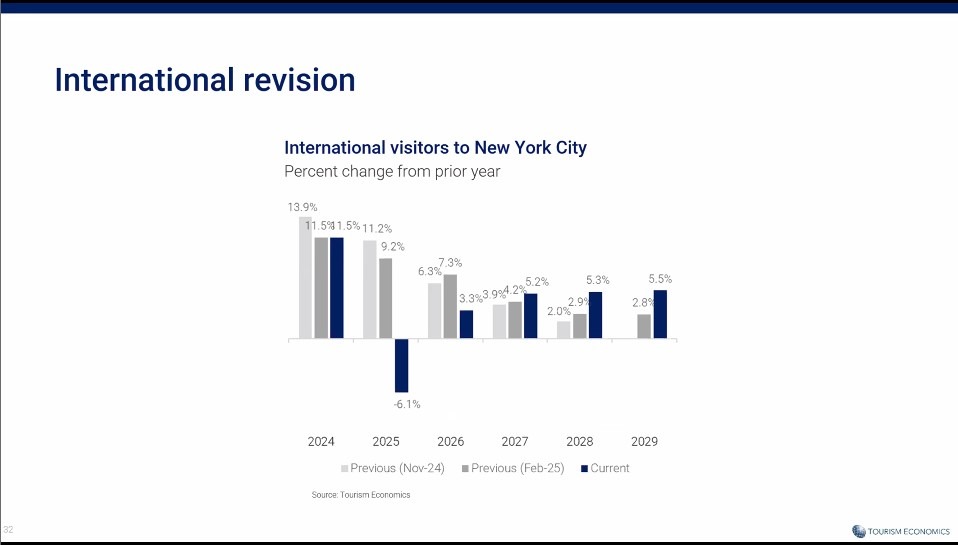
In 2025, Tourism Economics expected 64.1 million travelers to visit New York, a downgrade from the 67 million forecasted a few months ago, mostly because of declines in international travel, a sector heavily affected by President’s Trump tariffs. In 2025, international travel to the U.S. made a gigantic swing from 9% to -6.1%.

Narrowing visitation to the last four months, January through April, Glenn Hollister, vice president of sales strategy and effectiveness for United Airlines, highlighted airline industry trends through the three major airports used to get there: LaGuardia, Newark and JFK. “The story here for the first four months of the year is relatively positive,” he said. “Some of the weakness that we’ve seen as an industry has not really shown up when we look just at New York yet, certainly not in terms of the total passenger count.”

He ended on a positive note: “What is going on with the major airlines in New York is in the first four months of the year all of us carried more passengers than we did the year before. I think there are some warning signs that may be our reason for cautiousness but in terms of what we’ve actually seen the last four months, it’s a relatively positive picture, and we remain cautiously optimistic about that for the rest of the year.”

Several other speakers included:

  • Andrew van der Feltz, global senior director of business development for Expedia, who discussed the jet-setting trend, sparked by well-known shows like Emily in Paris and The White Lotus, which has driven visitation to the locations in which these shows take place, and New York’s position as one of the top 10 most-searched destinations
  • Steve O’ Malley, chief commercial officer for Maritz, who showed that in the association and trade show markets, the government sector has been the most affected and the tariffs have impacted exhibit builds.
  • Caroline Moultrie, president, EMEA, of MMGY Global, who focused on the United Kingdom and Ireland. “Despite some recent challenges, for example, policy uncertainty and the strength of the U.S. dollar, the UK consumer really does remain highly engaged with S. content, the ties between the U.S. and the U.K. are still thriving,” she said. “What’s really interesting in our research is that people feel a really strong emotional connection to individual US cities like New York, rather than they do perhaps the broader US brand message.”

In This Week’s Can’t-Miss Travel and Tourism News:

  • As of this week, domestic air travel within the U.S. officially requires a REAL ID, passport or other acceptable forms of identification. Make sure your documents will pass inspection before your next flight.
  • Palm Springs International Airport (PSP) has debuted Agua Caliente Oasis, a new concourse installation created in partnership with Agua Caliente Casinos. Inspired by the desert’s iconic style, the breezy lounge space features palm trees, midcentury design touches and plenty of charging stations. The installation is located in the Agua Caliente Concourse near Gates 12–20.
  • Wego, the Middle East’s top travel app, has teamed up with the Tourism Authority of Thailand to reignite interest in Thailand among MENA travelers. The campaign invites explorers to look beyond the usual hotspots and discover spiritual retreats, wellness escapes and vibrant food trails.
  • Villa Vie Residences has unveiled World Uncharted, a 301-day global voyage launching in 2027 that sets a new record for the world’s longest cruise. Designed for deep exploration, the journey spans five continents, 100+ countries and iconic stops like Antarctica, Easter Island and the Amazon.